
How to Pick Hunting Camo Patterns: A Practical Guide
Table of Contents
- Understanding How Game Animals See Camouflage
- Best Camo for Deer Hunting: Species-Specific Selection
- Camo Patterns for Different Terrains: Matching Your Environment
- Macro vs Micro Camo Patterns: What's the Real Difference
- The Human Silhouette and Breaking Up Your Outline
- Early Season vs Late Season Camo: Seasonal Transitions Matter
- Treestand vs Ground Hunting: Positioning Changes Everything
- Picking the Right Camo: A Step-by-Step Selection Process
- Frequently Asked Questions
Choosing the right hunting camo patterns is less about picking the coolest-looking print and more about understanding how your quarry actually sees the world. Many hunters default to whatever pattern is on sale, yet the real science of concealment hinges on matching your gear to specific terrain, light conditions, and the visual capabilities of the animal you are pursuing. This guide from Better Grab A Beer breaks down the practical decisions behind pattern selection so you can make a confident choice before you hit the timber.
Most guides get this wrong by treating camouflage as a one-size-fits-all purchase. The truth is that a pattern that works wonders in a Saskatchewan grain field can make you stand out like a sore thumb in a Georgia hardwood bottom. We will show you exactly how to analyze your hunting environment, your target species, and the season to pick a pattern that actually works. By the end, you will have a clear, step-by-step process for selecting gear that keeps you hidden when it matters most.
Understanding How Game Animals See Camouflage
The foundation of effective camouflage is not the pattern itself, but how it interacts with the vision of the animal you are hunting. Deer, for instance, are not colorblind in the way old folklore suggests, but their vision is heavily shifted toward the blue and yellow spectrum, making them highly sensitive to movement and UV-reflective brighteners (peer-reviewed research). Turkeys, on the other hand, have exceptional visual acuity and can detect fine details and colors that humans cannot, which is why photorealistic detail matters for them (peer-reviewed research).
Wildlife vision research consistently shows that contrast and movement, rather than exact color matching, are the primary triggers for detection (peer-reviewed research). A pattern that breaks up your outline and eliminates high-contrast blocks of solid color will outperform a "perfect" color match that sits in a smooth, unnatural shape. This is why the human silhouette is your greatest enemy, a topic we will explore in depth shortly.
Best Camo for Deer Hunting: Species-Specific Selection
When selecting the best camo for deer hunting, you must prioritize breaking up your silhouette over matching specific foliage colors. Because deer vision is limited in the red-green spectrum but sensitive to blues and UV light, patterns with softer, muted browns, grays, and greens work effectively across most whitetail habitats. The critical factor is avoiding patterns with large, dark, solid blocks that can create a stark silhouette against a lighter background.
For deer, consider patterns that feature a mix of macro and micro elements to disrupt your outline at various distances. A pattern that excels in this regard uses large, irregular shapes to mimic tree trunks and branches, layered with smaller, detailed leaves and twigs to provide texture at closer range. Remember that deer are masters of detecting motion, so your camo pattern is only part of the equation; staying still is non-negotiable.
Camo Patterns for Different Terrains: Matching Your Environment
Selecting camo patterns for different terrains requires you to move beyond generic "woods" patterns and analyze the dominant ground cover, tree species, and lighting of your specific hunting area. The goal is to match the macro appearance of your environment, the overall color and value, rather than the micro-details. If you hunt where the terrain is predominantly one color, a pattern with that dominant hue will be more effective than a busy, multi-colored pattern.
Woodland and Dense Vegetation
In dense timber, shadow play is your ally. Opt for patterns with darker browns, deep greens, and black to blend into the vertical lines of tree trunks and the deep shadows of the underbrush. A pattern with good vertical elements helps your form disappear into the maze of trunks and branches that define this environment.
Open Fields and Grasslands
Hunting open terrain demands a different approach. Here, the primary challenge is the lack of vertical structure. Patterns featuring lighter tans, khakis, and dead-grass yellows will better match the sun-bleached vegetation and open ground. You are trying to mimic the texture of grass and dirt, so a pattern with fine, horizontal micro-patterns is often more effective than large, dark shapes.
Agricultural and Transition Zones
Transition zones, like field edges and cutovers, require a versatile pattern. A mix of lighter field tones and darker timber shades allows you to sit effectively on the boundary between two habitats. The key is to pick a pattern that reflects the dominant vegetation of the specific edge you are hunting, whether that is standing corn, cut bean stubble, or thick briar patches.
Macro vs Micro Camo Patterns: What's the Real Difference
The debate between macro vs micro camo patterns comes down to the distance at which you expect to be detected. Macro patterns feature large, bold shapes designed to break up your silhouette at longer ranges, often 40 yards and beyond, where the eye first registers the overall shape of a target. Micro patterns are comprised of small, detailed elements that provide texture and mimic the fine details of foliage, which becomes critical at closer ranges where an animal can clearly discern individual leaves and twigs.
A common mistake is choosing a pattern with only one scale of detail. A purely macro pattern can look like a solid, unnatural blob up close, while a purely micro pattern may fail to disrupt your outline at a distance. The most effective patterns layer both, using large shapes to fool the initial scan and small details to prevent close-range detection. When choosing, think about your typical shot distance and the density of the vegetation you will be sitting in.
The Human Silhouette and Breaking Up Your Outline
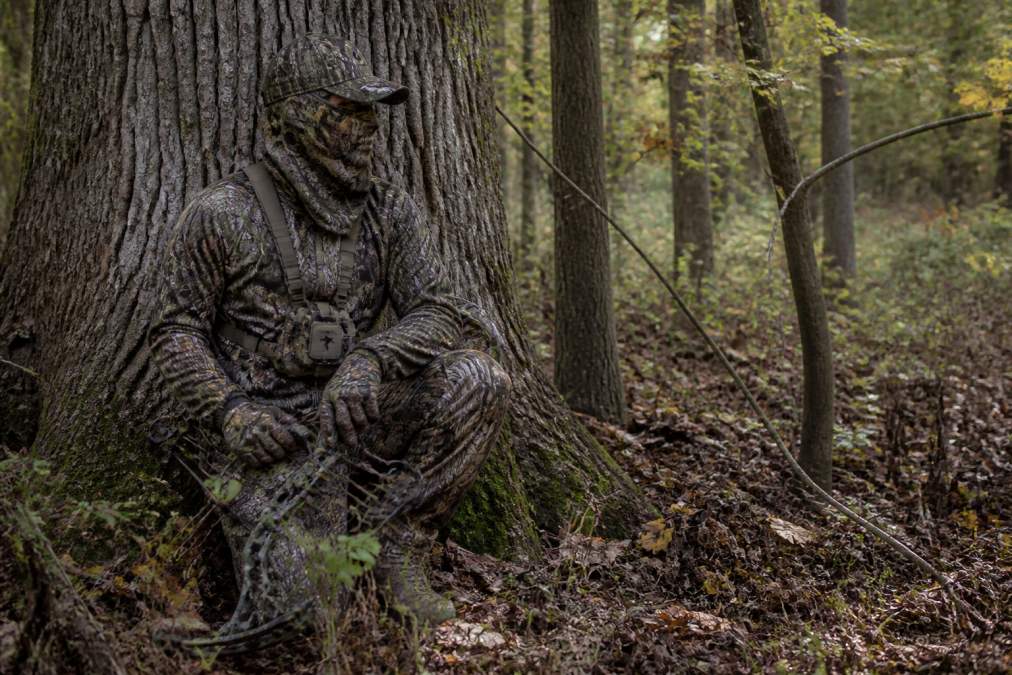
Your brain is wired to recognize the human form, and a deer's brain is equally adept at spotting that same shape. The primary job of any camo pattern is visual disruption: to break the continuous, recognizable outline of your shoulders, head, and torso into smaller, unidentifiable pieces. This is why a pattern that offers high contrast against your specific background is more important than one that simply has the "right" colors.
Movement is the ultimate giveaway, regardless of your pattern. A perfectly camouflaged hunter who turns their head quickly will be seen instantly. Effective concealment combines a high-disruption pattern with slow, deliberate movements and the use of natural cover to physically break up your outline, such as a bush or tree trunk in front of your position. Think of your camo as the final layer of a concealment system that starts with your choice of stand location.
Early Season vs Late Season Camo: Seasonal Transitions Matter
The foliage density of your hunting area changes dramatically from September to December, and your camo should change with it. Early-season hunting is characterized by thick, green vegetation, so patterns with a higher percentage of greens and darker shades help you blend into the lush canopy and undergrowth. As the season progresses, the environment shifts to a palette of browns, tans, and greys, making those green-heavy patterns stand out against the drab autumn backdrop.
Late-season camo must account for the stark, leafless woods and the potential for snow. Patterns that incorporate lighter greys and whites become invaluable for matching dead grass, bare branches, and snow-covered ground. Many hunters find that having at least two distinct patterns, one for the early season and one for the late season, is a more effective strategy than trying to find a single "universal" pattern that works year-round.
Treestand vs Ground Hunting: Positioning Changes Everything
Your hunting position dictates the background your camo must match, which is a factor many hunters overlook. From a treestand, your background is predominantly the forest floor and the vegetation below you, meaning a pattern with a strong vertical component and darker tones helps you blend into the tree trunk and the shadows behind you. The angle of the deer's view means they are often looking up into the tree, so matching the bark and canopy is key.
When hunting from a ground blind or on the ground, your background is the horizon and the terrain behind you. Here, you need a pattern that matches the horizontal layers of the landscape, the brush line, the grass, and the earth. A pattern that works well in a treestand may appear as a dark blob against a lighter sky when you are on the ground. Always choose your camo based on the backdrop you will be sitting against, not just the ground cover in front of you.
Picking the Right Camo: A Step-by-Step Selection Process
Now that you understand the science and the variables, you can apply a practical process to your next purchase. This selection framework moves beyond guesswork and gives you a repeatable method for evaluating any pattern.
Step 1: Identify Your Primary Hunting Environment
Start by writing down the specific terrains you hunt most often. Are you in dense hardwoods, open prairies, or agricultural fields? Be honest about where you spend 80% of your time, and use that location as your baseline.
Step 2: Determine Your Target Species and Their Vision
Consider how your primary game species sees the world. A deer's limited color vision requires a different approach than a turkey's sharp eyesight or a waterfowl's wide-angle view. This will dictate whether you need high-detail photorealism or strong silhouette disruption.
Step 3: Consider Seasonal Foliage Density
Map out your hunting calendar. If you only hunt the first two weeks of the season, a green-heavy pattern is a solid choice. If you are a late-season hunter, you will need to prioritize browns, greys, and possibly snow patterns.
Step 4: Account for Light and Shadow Conditions
Think about the time of day you hunt and the typical light levels. Patterns with high contrast work well in dappled light but can appear as a solid mass in deep shadow. Low-light conditions call for patterns that rely more on texture than on stark color differences.
Step 5: Test Before Committing
The most reliable way to evaluate a pattern is to test it in the field. Take the garment to your hunting spot, set it up in a realistic position, and walk back 30 to 50 yards to see how it blends. A pattern that looks great in the store can look completely wrong in the actual woods.
Selection Factor |
Primary Question |
Key Consideration |
|---|---|---|
Target Species |
How does their vision differ from mine? |
Deer: silhouette; Turkey: detail; Waterfowl: motion |
Terrain Type |
What is the dominant background color? |
Match macro color, not micro detail |
Season |
How dense is the foliage? |
Early season: greens; Late season: browns/greys |
Hunting Position |
What is the backdrop behind me? |
Treestand: vertical; Ground: horizontal |
A common concern is whether premium, high-tech patterns are necessary or if budget options work just as well. The reality is that the effectiveness of a pattern depends more on its color palette and shape disruption than its price tag. However, premium fabrics often offer advantages in moisture-wicking and durability, which are worth considering for long sits in extreme weather. For hunters who value gear that performs across a range of conditions, apparel that combines effective patterns with quality construction is a worthwhile investment.
Choosing the right camo is a process of matching your gear to your specific hunting reality. It requires honest assessment of your terrain, your target species, and the season, rather than relying on a single pattern to solve all your problems. At Better Grab A Beer, we build hunting apparel with performance-focused fabrics and camo patterns designed to withstand the rigors of the field while keeping you concealed. Get started with our hunting collection and gear up for a season of making the right call when it matters.
Frequently Asked Questions
What are the best hunting camo patterns for deer hunting?
The best camo for deer hunting depends on your specific terrain and season. Deer rely heavily on motion detection and have excellent color vision in the blue-yellow spectrum. For wooded areas with dense foliage, patterns with macro elements that match local vegetation work well. In open fields, patterns with longer sight lines and more open geometry are effective. Early season typically calls for leafy patterns matching green vegetation, while late season requires browns and grays as foliage thins. Field testing your pattern in your actual hunting location before season opens is the most reliable approach.
Does camo pattern really matter for deer hunting, or is movement more important?
Both matter, but differently. Movement and scent detection are what initially alert deer, but once they're looking in your direction, your camouflage pattern determines whether they identify you as a threat. Camo works by breaking up the human silhouette and matching the color spectrum and foliage density of your environment. A quality pattern that conceals your outline significantly improves your odds even if you move slightly. However, no pattern compensates for poor scent control or careless movement. The most effective approach combines appropriate camo selection with disciplined hunting practices.
What's the difference between macro and micro camo patterns, and which should I choose?
Macro patterns use larger, more visible pattern elements that work at distance by matching broad environmental features like tree trunks and large vegetation clumps. Micro patterns use smaller details that break up the human outline at closer ranges by mimicking fine details like twigs and leaf fragments. Your hunting distance, stand height, and specific terrain should guide your choice.
Can I use the same camo pattern for all my hunting, or do I need different patterns for different seasons?
A single universal pattern is a myth that oversimplifies the science of concealment. Early-season hunting with full green foliage requires patterns matching that color palette and foliage density. By late season, when vegetation is mostly gone, the same pattern becomes ineffective against the exposed brown and gray landscape. The most practical approach is selecting 2-3 patterns that cover your typical hunting conditions: one for early season with dense vegetation, one for late season with sparse foliage, and optionally one for transition periods. This balances effectiveness with practical gear investment.
This article was written using GrandRanker